
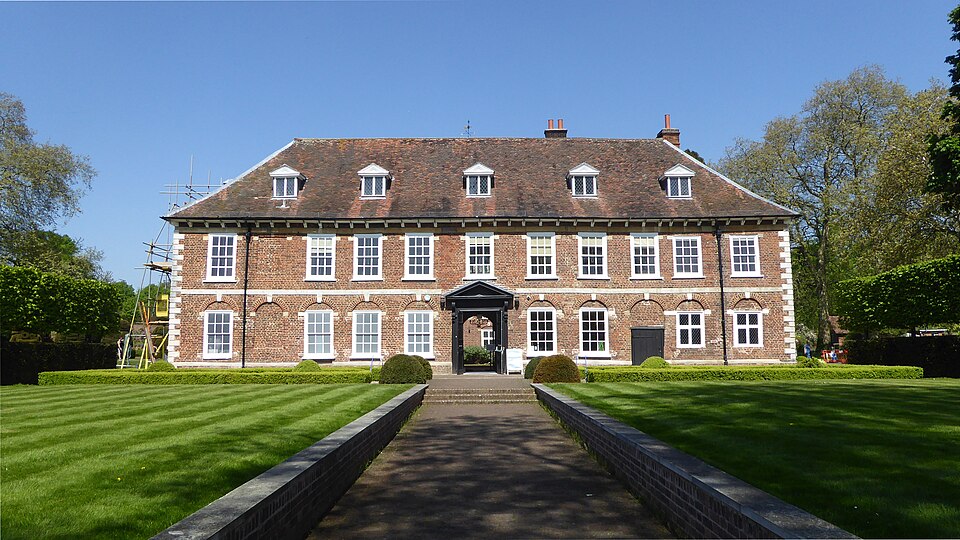
Hall Place & Gardens is the kind of place that rewards a slow look. From one side it appears as a chequered Tudor house of flint and stone. From another, it turns into a red-brick seventeenth-century mansion with a courtyard, tall windows and a clock tower rising above the roofline. Walk a few minutes and the scene changes again: clipped topiary beasts, glasshouses, riverside paths, meadows, owls, butterflies, an old mill site and a railway small enough to delight children without feeling like a theme park.
This guide is written for local residents, visitors to the London Borough of Bexley and anyone trying to understand why Hall Place matters. It follows the house from its medieval setting and Tudor rebuilding through the Austen, Dashwood and Limerick years, then explains its unusual Second World War life as the American intercept station known as Santa Fe. It also gives current visiting information for the gardens, tours, café, family attractions and travel.
Quick facts
| Address | Hall Place & Gardens, Bourne Road, Bexley, Kent, DA5 1PQ. |
|---|---|
| Borough | London Borough of Bexley, close to Bexley, Bexleyheath and Crayford. |
| Heritage status | Grade I listed building, Scheduled Monument and Grade II registered park and garden. |
| Main building dates | The present house began in 1537–40 for Sir John Champneys and was extended in red brick in the seventeenth century by Sir Robert Austen. |
| Best-known feature | The dramatic contrast between the chequered Tudor half and the red-brick Stuart wing, plus the Queen’s Beasts topiary in the gardens. |
| Gardens | About 65 hectares of gardens, parkland and riverside grounds, with free garden entry all year round. |
| Historic house access | The historic rooms are not open as a normal walk-in attraction. Visitors enter the house on selected pre-booked guided tours. |
| On-site attractions | London Butterfly Gardens, Jambs Owls Experience, miniature railway, Riverside Café, Stables Art Gallery, gift shop, plant areas, events and venue hire. |
Plan your visit
The gardens are the easiest way to enjoy Hall Place. They are free to enter and are open year-round, apart from the Christmas and New Year closure period published by the site. The Visitor Centre, Riverside Café, Stables Art Gallery and gardens are also listed by Hall Place as free-of-charge, while the house tours, London Butterfly Gardens and Jambs Owls Experience have separate charges.
As of the current Hall Place information, the gardens open daily at 9am. Summer closing is later than winter, and the Stone Arch Gate to the glasshouses and Visitor Centre closes earlier than the wider grounds. The safest approach is simple: treat the gardens as a daytime attraction, check the official opening page before travelling, and check again if you plan to visit late in the evening, around Christmas and New Year, or for a specific attraction.
| Garden entry | Free. Local byelaws apply inside the gardens. |
|---|---|
| House tours | Pre-booked only on selected dates. Public options include the Historic House Tour and the Codename Santa Fe wartime tour. |
| Group tours | Hall Place lists group tours at £10 per person including booking fee, with a minimum group size of 20 people. |
| By car | Just off the A2 at the Black Prince interchange. Hall Place states that free parking is available. |
| By rail | Bexley station is the nearest rail connection, around 15 minutes on foot, with taxis outside the station. |
| By bus | Local bus connections include 229, 492, B12 and 132 to the foot of Gravel Hill. |
| By bike | Bike racks are available in the car park, but bikes may not be ridden inside the gardens or parkland. |
| Dogs and pets | Dogs, cats and domestic pets are not allowed in the walled grounds, except registered assistance animals. Dogs must also be kept under control where permitted outside the formal area. |
Check live opening details
Hall Place is an active public site with private events, tours and seasonal partner attractions. Check the official pages before a long journey.
The setting beside the River Cray
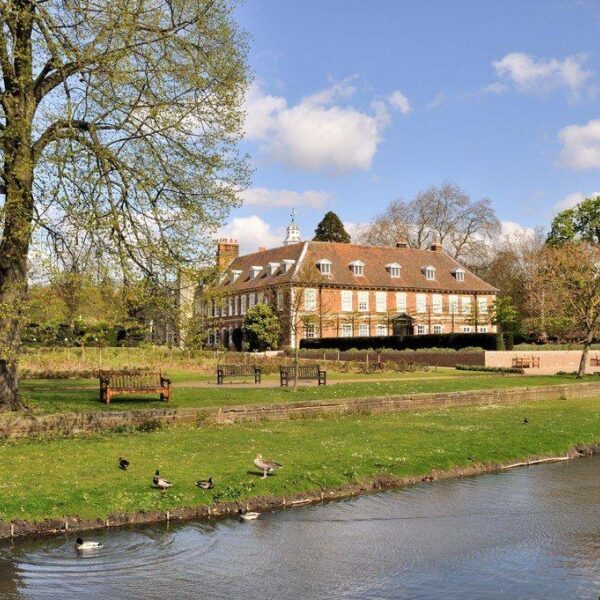
Hall Place stands on low, gently sloping ground between Bourne Road and the River Cray. That riverside setting is not a decorative extra. The river shaped the gardens, the former meadows, the mill site, the later café position and the way visitors move through the estate today.
The grounds extend for about 65 hectares. Near the house, the landscape feels formal: lawns, borders, topiary, walls, gates and clipped hedges. Further away, the mood softens into riverside walks, open ground, meadows and recreation space. Historic England’s park entry describes the River Cray as crossing the middle of the site, with the southern bank planted with weeping willows and a footbridge leading towards water meadows and sports pitches.
The modern visitor often arrives from the car park to the north-east, passing historic outbuildings before reaching the mansion. The route is useful because it reveals Hall Place gradually. At first you see a practical public attraction with parking, café, gallery and event spaces. Then the older order appears: walls, gates, flint, brick and the river line beyond.
The Tudor house and the Champneys family
The manor at Hall Place has deeper roots than the current building. Historic England records that the site replaced an earlier medieval manor house and notes evidence of earlier occupation, including reused medieval carved stone and archaeological finds from the riverbank. The present house, however, belongs mainly to the Tudor and Stuart periods.
Sir John Champneys, a wealthy City merchant and Lord Mayor of London in 1534, bought Hall Place in 1537 and began building between 1537 and 1540. Sources spell the family name in several ways, including Champneys, Champenois and Champneis. For a modern visitor guide, “Champneys” is the clearest spelling, but the older forms are worth knowing when reading Historic England entries and antiquarian sources.
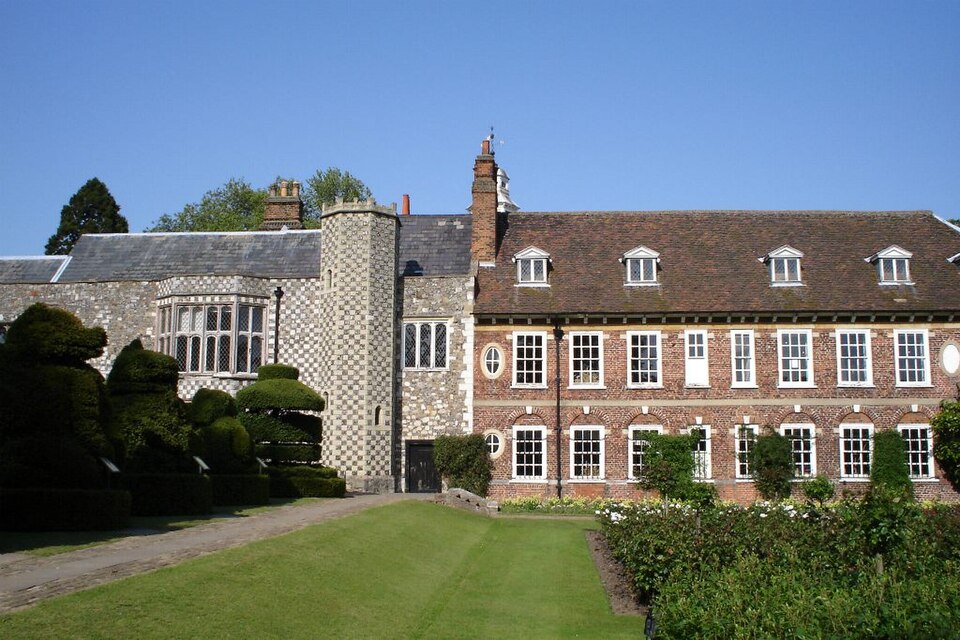
The Tudor house was built in stone and flint, with its most memorable exterior faced in a chequer pattern. This is the image many people remember: pale stone and darker flint arranged like a board game across the front of the house, broken by tall mullioned windows and projecting bays. It is not just picturesque. It is a strong surviving example of sixteenth-century masonry and a public statement of wealth, taste and status.
The earliest arrangement centred on the Great Hall, with wings extending north. Inside, Historic England notes a flat ribbed ceiling in the Great Hall, timber-framed cross passage walls, pine-panelled rooms in the wings and an upper room in the west wing that originally served as a chapel. The house still reads like a Tudor social machine: service spaces, ceremonial space, family rooms and controlled movement from one world into another.
Why the stone matters
Hall Place incorporates reused medieval carved stone. Older local traditions often connect some of this material with nearby dissolved religious houses, especially Lesnes Abbey or Dartford Priory. The safe wording is that reused medieval stone is present and that nearby monastic sources have long been suggested. That avoids turning a plausible tradition into a fact stronger than the evidence can carry.
Robert Austen and the red-brick wing
In 1649 Richard Champneys sold Hall Place to Robert Austen, a London merchant from Tenterden in Kent. Austen was knighted in 1660 and became the first baronet of Hall Place. He then reshaped the property on a scale that still defines the building.
Austen extended the southern part of the house in red brick. The result is not a discreet addition. It is a second house attached to the first, different in colour, rhythm, material and mood. The seventeenth-century work forms three sides of a quadrangle and has a deep hipped roof, sash windows, brick arcading, a modillion eaves cornice and a more regular, classical character than the Tudor half.
That contrast is the reason Hall Place is so memorable. Many historic houses hide their building phases behind later refacing. Hall Place does the opposite. It lets the join show. Stand where the flint-and-stone Tudor work meets Austen’s red brick and the house becomes a lesson in English domestic architecture without needing a lecture board.
The later rooms brought their own display. The Great Chamber, with its rich plaster ceiling, belongs to the seventeenth-century phase. The Long Gallery and other upstairs rooms helped turn the older manor into a house suitable for a different age of social life, status and movement.
Hall Place is not harmonious in the usual country-house sense. Its power lies in the visible argument between two periods: Tudor ambition in flint and stone, Stuart confidence in red brick.
Bexley Heritage Trust historical note
Dashwoods, school years and Lady Limerick
Hall Place remained with the Austen family until 1772, when the estate passed to Sir Francis Dashwood. Dashwood is a name with two very different associations. Publicly, he was a politician and Chancellor of the Exchequer in 1762–63. More notoriously, he became linked with the Hellfire Club, a private circle remembered for its scandalous reputation and theatrical irreverence.
The Dashwoods owned Hall Place for around 150 years, but they seldom used it as their principal home. From 1795 the house was leased as a school for young gentlemen. This long school period changed the way the building was used. Rooms designed for family status and hospitality became spaces of instruction, discipline and dormitory life.
From about the 1870s the house entered another phase. Maitland Dashwood, grandson of Sir Francis Dashwood, made changes with the architect Robert William Edis. They added the lodge, connected the house to the water mains and altered interiors with wood panelling and parquet flooring. These improvements helped prepare the property for fashionable tenants rather than full-time Dashwood occupation.
The late nineteenth and early twentieth centuries brought a series of aristocratic and well-connected tenants. Among them were Baron Emile d’Erlanger and his American wife Matilda, a former Gaiety Girl. The last private tenant was Lady Limerick, who lived at Hall Place from 1917 until 1943. She added mock-Tudor features, including beams and fireplaces, and helped give the house the romantic historic character that appeared in Country Life in 1922.
Lady Limerick also matters for the gardens. The clipped topiary figures that pre-date the Queen’s Beasts belong to her period. Sources differ on the exact year, placing them in the early 1930s, but they agree on the basic point: Hall Place’s famous living sculpture did not begin and end with the Coronation beasts of 1953.
Codename Santa Fe: Hall Place in the Second World War
Hall Place’s wartime story is one of the strongest reasons to treat the house as more than a pretty Tudor survival. In January 1944, the U.S. Army Signal Corps 6811th Signal Service Detachment arrived and set up an intercept station under the codename Santa Fe. The station formed part of the Allied signals-intelligence effort linked to Operation Ultra.
The work was practical, technical and secret. Aerial wires were strung across the rooftops. The Great Hall was converted into a set room, with banks of Hammarlund Super Pro radio receivers on wooden-plank tables. The Great Chamber became a dormitory. Operators worked around the clock intercepting encoded Morse signals, especially from the German Air Force and Luftwaffe, so the messages could feed into the wider Allied codebreaking system.
This changes the way one looks at the rooms. The Great Hall had already served Tudor ceremony, domestic hierarchy, later adaptation and public display. During the war it became an operational workspace. A room built to impress guests was turned into a listening post in a global conflict.
Visitor tip: choose the Codename Santa Fe tour if you are most interested in Second World War history. It focuses on how American soldiers used the historic rooms as a working intercept station, not just on the architecture of the house.
Gardens, topiary and wildlife
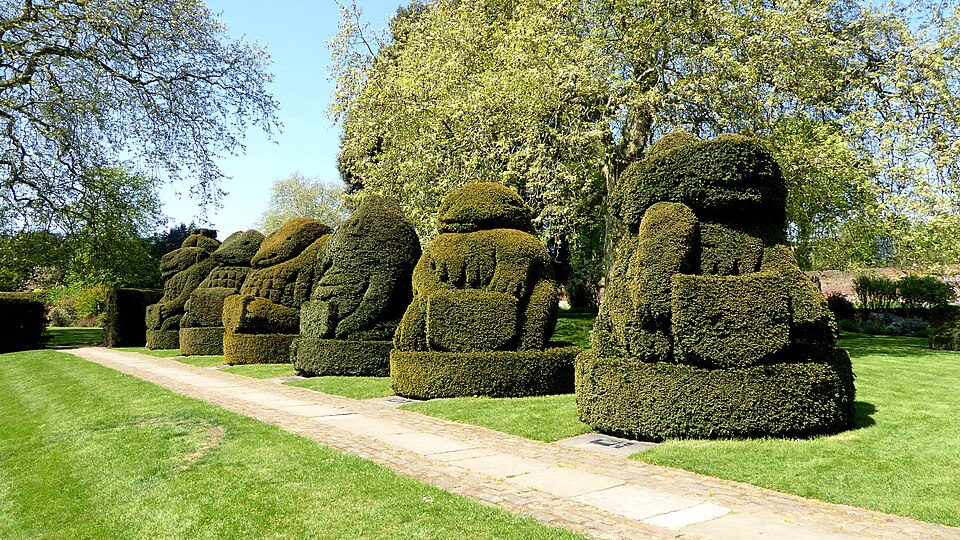
The gardens at Hall Place opened to the public in 1952, when HRH The Duchess of Kent formally opened them. The following year, the Queen’s Beasts topiary was planted to celebrate the coronation of Queen Elizabeth II. These yew figures now form the most photographed part of the gardens, but they sit within a wider landscape that includes Tudor and later garden walls, formal bedding, herbaceous borders, riverside lawns, a rose garden, herb garden, sunken garden, rock garden, water meadows and old kitchen-garden ground.
The Queen’s Beasts are heraldic animals, modelled on royal beasts associated with the monarchy. At Hall Place they work especially well because of their setting: clipped green forms against the chequered Tudor wall, with the River Cray nearby and the red-brick half of the house only a short walk away. They are playful, but not trivial. They connect Bexley’s public garden history with national ceremonial imagery.
Hall Place’s horticultural reputation is not based only on topiary. The official gardens page states that the gardens have won the Civic Trust’s Green Flag award every year since the award began in 1996 and also hold Green Heritage Site status. The same page asks visitors to respect local byelaws, including restrictions on dogs and pets, footballs, barbecues, fishing and drones, so the gardens and river can be protected.
The walled gardens and glasshouses
The walled garden area sits east of the house and has long been linked with productive horticulture. Historic garden records describe a kitchen garden on this site from the estate map of 1700, with later nineteenth-century vineries, hot houses, cucumber houses, forcing pits, sheds, tool house, melon ground, orchard and asparagus beds. Today visitors know this area for glasshouses, plant displays and the London Butterfly Gardens.
London Butterfly Gardens
London Butterfly Gardens is an independent partner attraction inside the restored Main Glasshouse. It recreates a warm, humid tropical flight area for hundreds of live butterflies and tropical plants. A separate Living World area includes insects such as leaf and stick insects, praying mantids, jungle nymphs, katydids, spiders and leaf-cutting ants. Tickets are separate from garden entry.
Jambs Owls Experience
Jambs Owls is another independent partner attraction on site. It introduces visitors to owls and other species, with staff explaining behaviour, diet and nocturnal habits. The official page currently notes bird-flu precautions, including no touching or holding by visitors, antibacterial foot mat use and hand-washing or sanitising points. Again, this attraction has a separate charge.
Miniature railway
The miniature railway is run by Welling and District Model Engineering Society. It is seasonal, volunteer-led and usually runs on Sunday afternoons in spring and summer. The line is reached by crossing the weir bridge near the Visitor Centre and turning left. It is a small detail in the estate’s long history, but for families it can become the moment children remember most clearly.
Hall Place today
Hall Place now works on several levels at once. It is a protected historic building, a public garden, a museum and exhibition setting, a family day out, a wedding and events venue, a riverside café stop and a living piece of Bexley’s civic identity.
The Historic House is available through pre-booked guided tours rather than open-room wandering. A standard Historic House Tour explains how the house changed with each owner from the sixteenth century onwards and includes access to exhibition galleries and objects from the Bexley Museum Collection. The Santa Fe tour gives the Second World War story more space.
The Riverside Café sits beside the River Cray and opens when the main Visitor Centre is open. It serves teas, coffees, sandwiches and seasonal menu options, with gluten-free, dairy-free and healthier choices listed by the venue. The Stables Art Gallery and shop add a local art and visitor-centre layer to the historic estate.
For a first visit, allow at least two hours for the gardens, more if you plan to use the café, visit the butterfly house or owls, walk the river path, ride the miniature railway or join a house tour. For a history-led visit, book a tour first and build the garden walk around it. For a family visit, check the events calendar before setting out, because the railway, owls, butterflies and seasonal activities follow their own opening patterns.
Chronology of Hall Place & Gardens
The dates below bring together the medieval manor, the Tudor and Stuart building phases, later tenants, wartime use and the public garden period.
Historic England notes early claims for the manor’s origins, with the site later first securely mentioned in the thirteenth century.
Sir John Champneys serves as Lord Mayor of London.
Champneys purchases Hall Place and starts the present Tudor house on the site of an earlier medieval manor.
The stone-and-flint house is built, with the Great Hall at its centre and a distinctive chequered exterior.
Champneys dies. His son Justinian inherits the property and alters or enlarges the house.
Richard Champneys sells Hall Place to Robert Austen, a London merchant from Tenterden.
Robert Austen extends the southern side of the house in red brick, creating the strong Tudor-versus-Stuart contrast visible today.
Austen is knighted and later becomes associated with the Austen baronetcy of Hall Place.
The Austen line ends without a direct heir and Hall Place passes to Sir Francis Dashwood.
The house begins a long period as a school for young gentlemen.
Maitland Dashwood and architect Robert William Edis make changes, including the lodge and interior alterations.
Lady Limerick becomes the last private tenant of Hall Place.
Hall Place and Lady Limerick appear in Country Life, helping fix the house in the public imagination as a romantic historic interior.
James Cox Brady buys the property.
Lady Limerick’s topiary figures are planted in the gardens.
James Cox Brady sells Hall Place to Bexley Council.
The U.S. Army Signal Corps 6811th Signal Service Detachment arrives and establishes the Santa Fe intercept station.
Santa Fe operates as part of the Allied Ultra signals-intelligence effort, with receivers in the Great Hall and soldiers sleeping in the Great Chamber.
The gardens open to the public, formally opened by HRH The Duchess of Kent.
The Queen’s Beasts topiary is planted for the coronation of Queen Elizabeth II. Hall Place is also first listed at Grade I.
Hall Place is entered on the Register of Parks and Gardens as Grade II.
Hall Place begins its run of Green Flag recognition, according to the official gardens page.
Major visitor improvements and restoration work reshape the public offer, including new visitor facilities and wider interpretation.
Hall Place continues as a public garden and event venue, with Historic House and Santa Fe tours offered on selected pre-booked dates.
What to look for on a walk around Hall Place
- The join between the two halves: stand where the Tudor chequerwork meets the red-brick seventeenth-century wing.
- The Great Hall exterior: look for the tall canted bays and stone-mullioned windows on the north front.
- The courtyard: the red-brick southern section gives Hall Place a different, more formal seventeenth-century face.
- The Queen’s Beasts: walk the topiary line slowly rather than treating it as a quick photo stop.
- The older topiary: compare the coronation beasts with the earlier clipped forms associated with Lady Limerick.
- The River Cray: follow the river edge to understand why the house, gardens, mill site and café all belong together.
- The walled garden area: this was once productive estate ground and later became central to plant displays and glasshouse attractions.
- The old outbuildings: the barn, stables and lodge show how much of the estate’s working life survives beyond the mansion itself.
Sources and further reading
This page prioritises official Hall Place pages, Historic England records and recognised garden-history sources. Visitor information can change, so the official Hall Place website should be treated as the live source for tours, opening times, partner attractions and byelaws.