
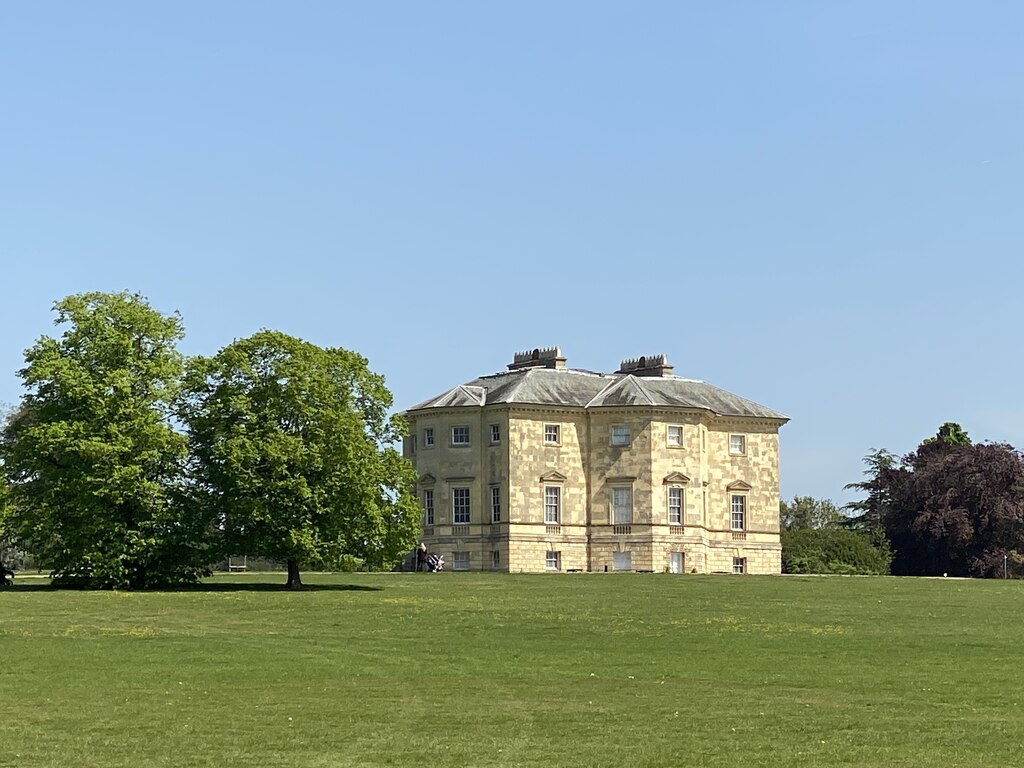
Danson House is easy to admire and rather harder to read. From the park it appears almost self-contained: a pale classical house on high ground, formal enough for ceremony, familiar enough to be part of ordinary Bexley life. Yet the building and the land around it belong to a much longer story: medieval fields and woodland, a Georgian merchant’s ambition, a designed landscape of water and views, nineteenth-century ownership, municipal pride, twentieth-century neglect, and one of London’s most important country-house restorations.
This page follows that story in order. It treats Danson House and Danson Park together, because the house was never meant to be understood as an isolated object. The villa, the lake, the old drives, the surviving gardens, the stables and the Charter Oak are fragments of one estate, altered repeatedly as Bexley changed from Kentish countryside into south-east London suburbia.
Quick facts
| Location | Danson Park, between Bexleyheath and Welling, London Borough of Bexley. |
|---|---|
| House status | Grade I listed building, officially listed as Danson Park Mansion by Historic England. |
| Park status | Grade II registered park and garden of special historic interest. |
| Architect | Sir Robert Taylor, one of the leading English architects of the Georgian period. |
| Main patron | Sir John Boyd, a City merchant whose fortune was tied to the West Indies sugar trade and the wider imperial economy of the eighteenth century. |
| Construction period | The safest reading is 1762–66 for the main villa, with further completion, decoration and landscape work continuing into the early 1770s. |
| Landscape designer | Long associated with Capability Brown, but Historic England now attributes the surviving eighteenth-century park scheme more closely to Nathaniel Richmond, Brown’s assistant and a landscape improver in the Brownian manner. |
| Current use | Bexley’s official Register Office, with ceremonies and selected heritage access. Danson Park is a public park open year-round. |
Before the villa: Danson as an estate
The ground on which Danson House stands was not empty when Sir John Boyd arrived. The estate had an older life, remembered in early forms of the name such as Dansington. By the sixteenth and seventeenth centuries this was a Kentish estate of woodland, arable land, pasture and water. It was not yet the open municipal park known today, nor the single grand composition created in Boyd’s lifetime.
Historic England records that between 1571 and 1723 the original estate grew from about 100 acres to about 250 acres. This was a significant expansion. It tells us that Danson was already being assembled and improved long before the Palladian villa was built. The estate was becoming something more than productive land: waterworks, fishponds and ornamental features were part of its identity.
In 1695 the estate was bought by John Styleman, a retired East India merchant. His purchase is one of the first firm points in the modern history of Danson. Styleman’s will later linked the estate to charitable provision in Bexley, directing part of its value towards almshouses for local poor families. This is one reason Danson’s history is not only about elite taste. The fortunes of landowners, tenants, merchants, servants and poorer residents were bound together in legal arrangements that lasted long after individual owners had died.
John Selwyn and the old landscape
In 1723 Styleman leased Danson to John Selwyn MP, a courtier and former aide-de-camp to the Duke of Marlborough. Selwyn improved the estate with serious intent. The lease required him to spend at least £1,000 on improvements, a large sum that shows how deliberately the property was being transformed.
By the mid-eighteenth century the old manor house stood in the valley south of the present villa, near the eastern boundary of the estate. The public road from Danson to Blendon once ran uncomfortably close to it. Selwyn bought land from neighbours so the road could be moved away, a change made around 1745–46. He also enlarged and ornamented the grounds. Contemporary and later accounts refer to a formal canal, lakes, a small island, a Chinese pavilion reached by bridges, a temple and a tea house. These vanished features matter because they show that Boyd did not create beauty at Danson from nothing. He inherited a cultivated landscape and then remade it on a grander, more fashionable scale.
Danson House was built to be seen, but also to see from. Its architecture and landscape were arranged as a conversation between stone, water, trees and social ambition.
Bexley Heritage Trust historical note
Sir John Boyd and the making of Danson Hill
John Boyd entered the story in 1753, when he took a repairing lease of the old Danson estate. He was already a prosperous City merchant, and by the later eighteenth century he would be known as Sir John Boyd, baronet. His wealth was connected to the West Indies sugar trade and to the imperial commercial networks of the period. Any honest account of Danson House has to include that context. The villa was a work of taste, but also a monument built from colonial commerce.
By 1759 Boyd had purchased the freehold interest in the estate. The remaining legal complications were settled through a private Act in 1762, often called the Styleman Act in discussions of Danson’s history. That Act cleared the way for the full reshaping of the property. The old house in the valley would no longer do for a man of Boyd’s means and aspirations. He wanted a modern villa on higher ground.
Plans were under way by 1762–63. A plan drawn by the Reverend Joseph Spence in 1763 shows the site of the new mansion. Another plan for proposed alterations at Danson Hill belongs to the same moment. The house was placed to the north of the older mansion, on a ridge with falling ground to the south and views towards the future lake. It was a deliberate act of repositioning: the new owner moved the centre of the estate from a valley house to a commanding classical villa.
Local summaries often say that Danson House was built in 1766 for Boyd’s second wife, Catherine Chapone. That is a useful shorthand, but the fuller chronology is more subtle. Construction began in the early 1760s, the main house was substantially complete by the mid-to-late 1760s, and interior and landscape work continued into the early 1770s. Boyd married Catherine Chapone in 1766, the same period in which the new house was being completed and extended with wings for offices and stables.
In 1775 Boyd was created a baronet. By the time of his death in 1800, Danson stood at the centre of an estate of more than 600 acres, combining pleasure grounds, agricultural land, water, planting and buildings. What survives today is only a reduced remnant, but the surviving house and park still make sense if they are read against that larger vanished estate.
The architecture: Robert Taylor’s compact Georgian villa
Danson House was designed by Sir Robert Taylor, an architect whose name is also associated with the Bank of England. Taylor’s achievement at Danson is not size alone. The house is restrained, compact and carefully judged. Historic England describes it as one of the finest surviving villas by Taylor, and that judgement is easy to understand when one looks at the plan.
The building is Palladian in spirit: balanced fronts, classical detail, a raised principal floor and an air of controlled dignity. Historic England’s official list entry describes the house as built of Portland stone, with a rusticated ground floor, three storeys, a slate roof and principal apartments on the first floor. The north front, where visitors approach the entrance, has a square central projection beneath a pediment with a round window. Nineteen broad steps rise to the front door on the piano nobile.
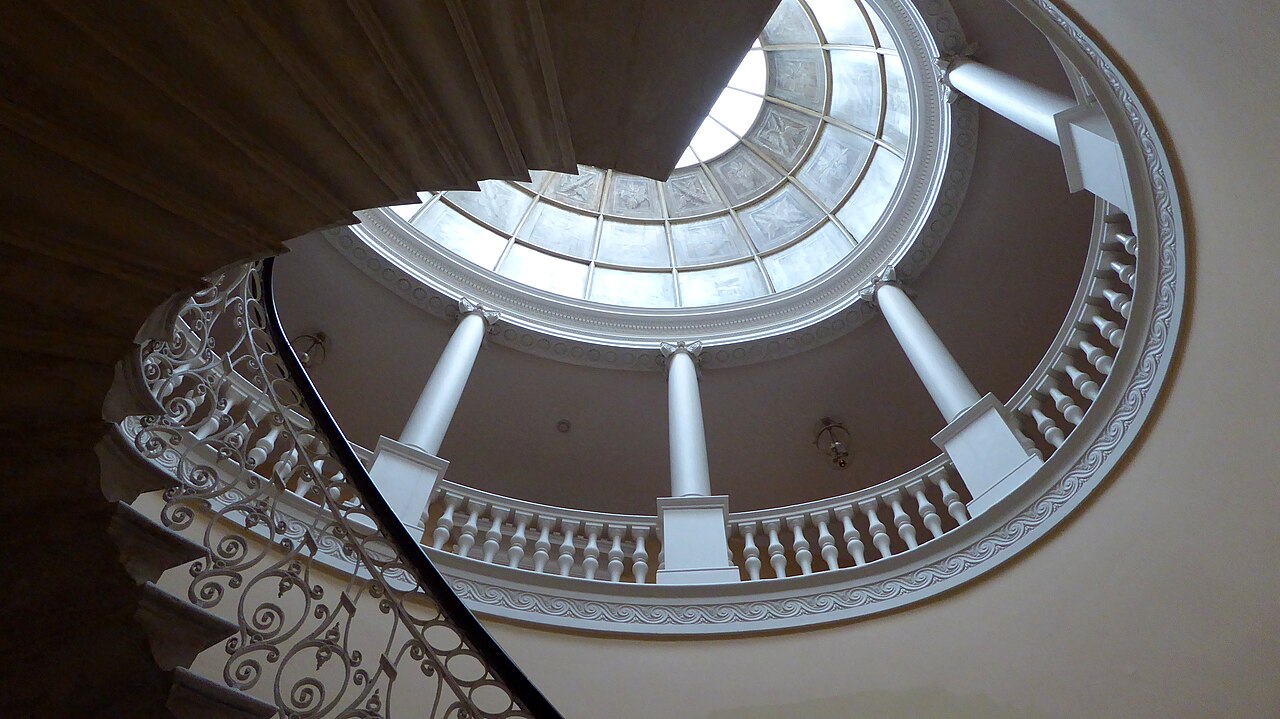
Inside, the central feature is the oval staircase. The stair rises beneath an oval dome, with a gallery of eight Ionic columns on the second floor. Around it were arranged the public rooms of a Georgian villa: entrance hall, dining room, saloon, library and family rooms. This compact arrangement allowed the house to work as a place of reception. Guests moved through spaces designed for conversation, dining, art, ceremony and display.
William Chambers and the art of finishing
Sir William Chambers, another major architect of the Georgian age, was brought in to enrich the house and grounds. He designed chimney pieces, picture frames and garden buildings. His involvement does not make Danson House a Chambers house rather than a Taylor house; instead, it shows Boyd’s determination to finish his villa with fashionable artistic authority.
Boyd also commissioned the French Provençal artist Charles Pavillon to paint allegorical panels for the dining room. These were not casual decorative touches. In an eighteenth-century country house, rooms communicated messages about taste, education, wealth and moral identity. The dining room, saloon and library were spaces in which a host presented himself to guests. At Danson, that performance was architectural, artistic and social.
Why dates differ: some public summaries use 1766 as the date of Danson House. Historic England’s publication gives 1762–66 for the villa, while the park register and later research show continuing work into 1770–73. For a careful historical article, it is better to say that Danson House was built in the 1760s, with construction beginning around 1762–63 and the main house substantially complete by 1766.
The park, the lake and the Brownian landscape
Danson Park is often described as a Capability Brown landscape. Older sources used that attribution confidently, and the house’s setting certainly belongs to the broad Brownian world of smooth lawns, water, clumps of trees and apparently natural views. The modern Historic England register is more cautious and more precise. It attributes the surviving eighteenth-century landscape scheme to Nathaniel Richmond, a landscape improver associated with Brown’s circle.
This distinction is not a dry scholarly correction. It changes how we look at the park. Danson was not simply stamped with a famous name. It was the result of planning, adjustment and local circumstance. The lake, the ridge, the old stream, the lost road, the valley and the new house all had to be made to work together.
The lake is the most powerful surviving element of that composition. Richmond’s plan of 1762–63 showed a more complex arrangement of interlocking lakes, plantations and a false island. By 1770 the eastern section of the lake was under construction, and Chambers had been asked to design a temple at the eastern end and a bridge at the western end. The temple and bridge have gone, but the water remains the visual anchor of the park.
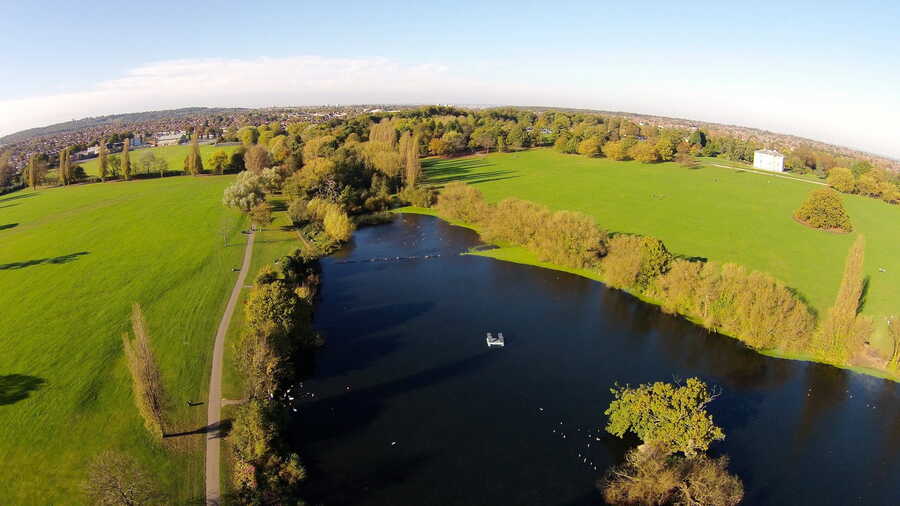
The present park is about 74 hectares. It is enclosed today by suburban streets and the A2, but the older landscape was far larger. The modern visitor sees a public park with football pitches, paths, play areas, water sports, cafés, gardens and woodland. Beneath that everyday use are older lines: the ridge on which the house stands, the fall of ground towards the lake, the remnants of planting, the position of the stables and the trace of former approaches.
The Old English Garden, Rock Garden and Peace Garden
The Old English Garden, opposite the house, belongs not to Boyd’s Georgian scheme but to the municipal park period. It was laid out on former parkland and probably dates from the early years after the council opened Danson as a public park in the 1920s. The Rock Garden lies towards the west end of the lake, close to the water garden and the stream feeding the lake. The Peace Garden is found in the south-eastern part of the park.
These gardens show the park’s second life. After 1925 Danson was no longer designed around the comfort and prestige of one household. It was adapted for the public: walking, sport, boating, children’s play, remembrance, local events and ordinary recreation. That is why Danson’s history did not end when the estate was sold. It changed audience.
After Boyd: debt, sale and nineteenth-century ownership
Sir John Boyd died in 1800. His son, the second baronet, inherited both the house and the financial strain attached to it. Between 1802 and 1804 he undertook repairs and improvements, but also made a decisive alteration: the wings added to the house in Boyd’s lifetime were demolished. A new stable block was built at a greater distance from the house, using material from the demolished wings.
The estate was sold to John Johnston in 1807. The Johnston family held Danson until 1862. Their period seems to have been less dramatic than Boyd’s, but it left marks on the gardens and planting. Estate plans and Ordnance Survey maps show changes to lawns, paths and planted areas during the nineteenth century.
In 1862 Danson was sold to Alfred Bean, a figure closely associated with the growth of Bexleyheath. Bean and his descendants owned the estate into the early twentieth century. By then, the world that had produced the Georgian villa had altered beyond recognition. Railways, suburban growth and road construction were changing Bexley. Large private estates around London were increasingly vulnerable to sale, division and development.
From private estate to public park
After the death of Alfred Bean’s widow in 1921, the property was auctioned. The sale map of 1922 recorded an estate already under pressure. In 1924 Bexley Urban District Council purchased the house, stables, lake and about 74 hectares of parkland. The remaining estate was developed for housing and the construction of the A2 trunk road.
In 1925 Danson opened as a public park. The house, then often called The Mansion, housed a museum and a café. This was a profound change in meaning. A private landscape made for status and controlled access became a civic amenity. The lake, once part of a gentleman’s prospect, became a place for boating. The grounds became football fields, gardens, paths and gathering places.
On 30 September 1937, the large oak now known as the Charter Oak became part of borough memory when Lord Cornwallis presented the charter that redesignated Bexley from an urban district to a municipal borough. The oak is now recognised as one of the Great Trees of London and remains one of the park’s most important living landmarks.
During the Second World War the lake was filled in because it was considered a possible landmark for enemy aircraft. It was later re-excavated and returned to public use. This episode is a reminder that even landscape features can have wartime histories: water, from the air, could be as legible as a building.
Decline, risk and restoration
Public ownership saved much of Danson Park, but it did not immediately secure the future of the house. The mansion closed in 1970 and stood empty for many years. By the late twentieth century its condition had become a serious concern. Bexley Council records that in 1995 English Heritage identified Danson House as “the most significant building at risk in London”.
That judgement marked the beginning of a major restoration. English Heritage led conservation work between 1995 and 2004. The restoration was not simply a matter of making the building safe. Specialists studied paint, plaster, joinery, room arrangements, documentary evidence and surviving fabric in order to understand how the house had changed. The goal was to recover, as far as possible, the appearance and architectural logic of the villa as it had been completed in the late 1760s.
The restored interior opened to the public in 2005 for the first time in thirty years. In July that year, Danson House was officially re-opened by HM Queen Elizabeth II. The park and gardens also benefited from Heritage Lottery Fund-supported renovation, with a programme completed in 2006.
Bexley Heritage Trust later managed Danson House alongside its wider heritage work in the borough. In 2016, after the London Borough of Bexley withdrew its grant because of financial pressures, the Trust announced that it would hand back management of the house. The council took responsibility and made arrangements to move the borough’s Register Office to Danson House from Sidcup Manor House. That administrative change brought another chapter: the restored Georgian villa became a working civic ceremony building.
Danson House today
Today Danson House is Bexley’s official Register Office, run by Kent County Council on behalf of the London Borough of Bexley. It is used for weddings, citizenship ceremonies, renewal of vows, notice of marriage appointments and the registration of births and deaths. The building therefore continues to act as a place of ceremony, although its audience is now public and civic rather than private and aristocratic.
Heritage access is limited rather than daily. Bexley’s current visitor information states that tours are offered on selected dates between April and August, with free entry to the principal floor during morning openings and guided tours at midday. As public access can change, visitors should always check the council’s live page before travelling.
Danson Park itself remains open year-round and is one of Bexley’s major green spaces. It has formal gardens, a large lake, water sports, a boathouse café, play areas, paths, sports facilities and wildlife interest. The park is not a frozen eighteenth-century landscape, and that is part of its value. It is a layered public place where the Georgian estate, the municipal park and contemporary Bexley all overlap.
Planning a visit?
Check current access before travelling. Danson Park is open year-round, but tours and ceremonies inside Danson House follow separate arrangements.
Chronology of Danson House and Danson Park
The dates below bring together the estate, house, landscape and public park. Some early dates are approximate because the surviving evidence is drawn from estate plans, leases, maps and later historical research.
An estate at Danson is believed to have earlier medieval roots, with land used for arable, pasture and woodland.
The estate, known in the sixteenth century as Dansington, expands from about 100 acres to about 250 acres, with waterworks and fishponds.
John Styleman, a retired East India merchant, buys the Danson estate.
Styleman leases the estate to John Selwyn MP, who is required to spend at least £1,000 improving it.
Selwyn’s improvements include moving the public road from Danson to Blendon away from the old manor house.
John Selwyn dies. The lease later passes through his widow before Boyd takes control.
John Boyd takes a repairing lease of the old Danson House and estate.
Boyd purchases the freehold interest in the estate.
A private Act settles the remaining freehold complications and enables Boyd to proceed with major redevelopment.
Plans show the new mansion on its present ridge-top site; construction of the Palladian villa begins around this period.
The new house is substantially complete and augmented with two wings, one for stables and one for offices. Boyd marries Catherine Chapone.
Andrews, Drury and Herbert’s Map of Kent shows the new mansion and its wings.
Sir William Chambers is commissioned to design a temple and bridge for the park as the lake works progress.
Boyd reports Chambers’s temple complete. Landscaping and finishing work continue to shape the estate’s mature Georgian character.
John Boyd is created a baronet.
Sir John Boyd dies, leaving the estate to his son.
The second Sir John Boyd undertakes repairs, demolishes the wings and builds a separate stable block using material from them.
A sale plan records the estate and many of the Boyd family’s alterations.
Danson is sold to John Johnston.
John Johnston dies; the Johnston family continues to hold the estate until the 1860s.
Alfred Bean buys Danson, beginning the final major period of private estate ownership.
After the death of Bean’s widow, the property is auctioned and mapped for sale.
Bexley Urban District Council buys the house, stables, lake and about 74 hectares of parkland.
Danson opens as a public park. The mansion houses a museum and café.
The Charter Oak becomes associated with Bexley’s new municipal borough charter.
During the Second World War the lake is filled in as a possible landmark for enemy aircraft, then later re-excavated.
Danson Park Mansion is first listed as a Grade I building.
The mansion closes and remains empty for many years.
Danson Park is entered on the Register of Parks and Gardens as Grade II.
English Heritage identifies Danson House as the most significant building at risk in London and begins the rescue phase.
Major conservation and restoration work is carried out by English Heritage.
The restored interior opens to the public for the first time in thirty years; HM Queen Elizabeth II officially re-opens Danson House in July.
Heritage Lottery Fund-supported restoration of the park and gardens is completed.
Bexley Heritage Trust withdraws from managing Danson House after the withdrawal of council grant funding; the council prepares to use the house as the borough Register Office.
Danson Park marks 100 years as a public park.
Danson House continues as Bexley’s Register Office, with heritage tour dates advertised by the council for the April–August season.
What to look for on a walk around Danson
- The north front: the formal entrance, broad steps and pediment show the villa at its most public and ceremonial.
- The southward view: look from the house towards the lake to understand why the villa was placed on high ground.
- The lake: the strongest surviving feature of the eighteenth-century landscape design.
- The Old English Garden: a later municipal garden, important to the park’s twentieth-century life rather than Boyd’s original scheme.
- The stables: a Grade II* building connected with the post-Boyd reshaping of the estate.
- The Charter Oak: a living civic landmark associated with Bexley’s 1937 borough charter.
- The edges of the park: the A2 and surrounding streets show how much of the old estate was lost to twentieth-century development.
Sources and further reading
This page has been written from British and official heritage sources where possible, with public-facing visitor information separated from historical interpretation.
Editorial note: older sources sometimes repeat the Capability Brown attribution. This page follows Historic England’s current wording and names Nathaniel Richmond as the more precise attribution while acknowledging the Brownian landscape tradition.